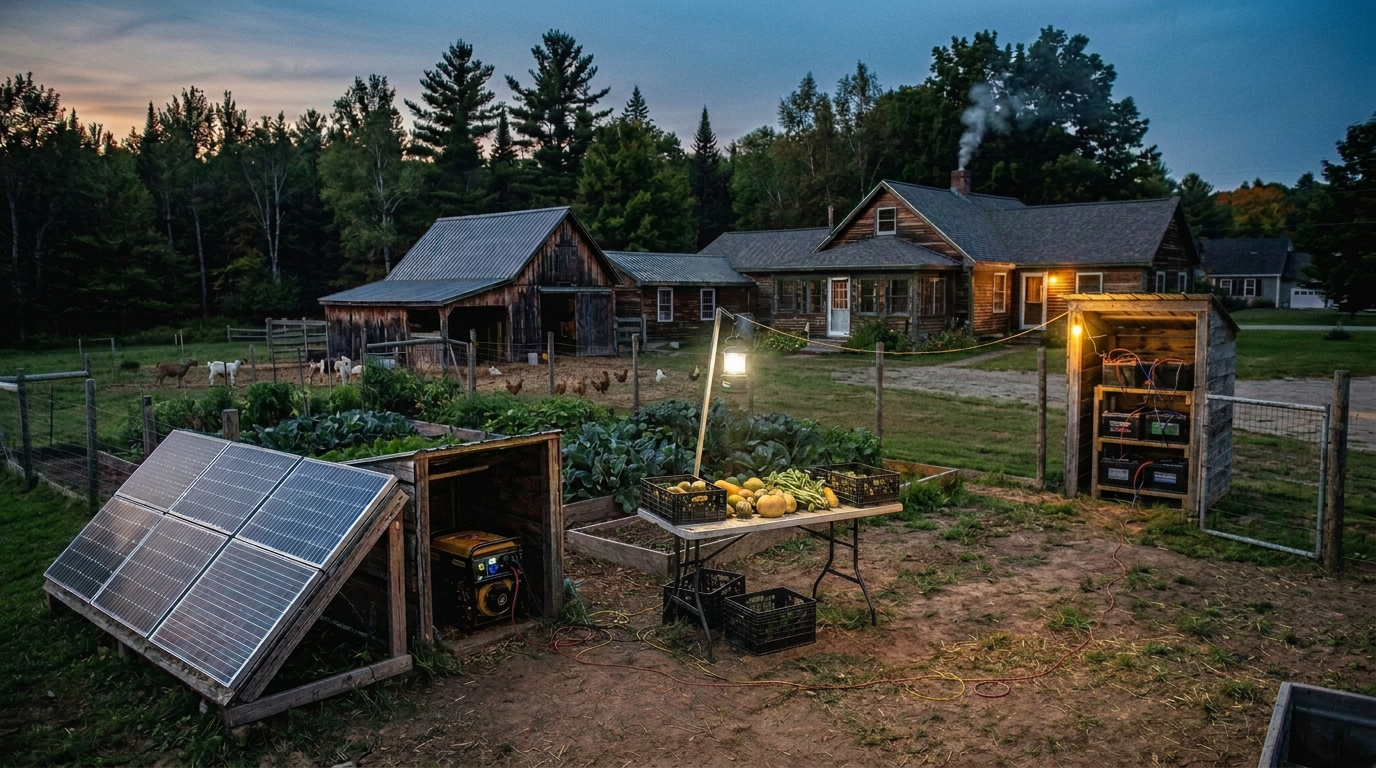
You don't need a massive generator, thousands of dollars in batteries, or a whole-house solar system to become more resilient. You just need to start somewhere.
At Resilient Acres, our backup-power system didn't appear overnight.
Years ago, our emergency power capability was much simpler. We had small inverters that could run electronics from a vehicle battery. During one winter blackout, my wife powered the lights and computer in her home office using an inverter connected to her car. She was able to keep working while the grid was down.
Today, we're approaching the point where our home could operate independently of the electrical grid for extended periods.
There were a lot of steps—and some mistakes—between those two points.
That's why one of the most important lessons we've learned about resilience is this:
Don't wait until you can build the perfect system. Solve one problem, test your solution, and then add another layer.
Layer 1: Start With Light
Imagine waking up at 2:00 in the morning and realizing the electricity is out.
If you live in the country like we do, darkness can mean darkness.
Your first problem isn't generating 10,000 watts of electricity. It's getting out of bed without tripping over a dog or something left on the floor.
That's why we keep small flashlights throughout our home: beside the bed, in bathrooms, in the living room, kitchen and near entrances.
We didn't start doing that because some preparedness manual told us to.
We did it because, more than once, we found ourselves standing somewhere needing a flashlight—and realizing the flashlight was in another room.
We also use headlamps, penlights, magnetic work lights and larger lights powered by our cordless-tool batteries.
We've purchased some excellent inexpensive lights. We've also purchased junk.
Buy equipment. Use it. Test it.
Finding out during a blackout that the flashlight you were depending on doesn't work is too late.
Children can benefit from having their own flashlights, too. Darkness can be frightening, and having their own source of light can provide a sense of security and even allow them to help with simple household tasks.
Sometimes a few battery-powered lights are all you need. You may not need to start a generator at all.
Layer 2: Keep the Small Things Running
If your biggest concern is keeping phones or tablets charged, don't begin by shopping for a whole-house generator.
Start with a battery pack.
Some portable power banks can keep a phone operating for days, depending on their capacity and how the phone is used.
Vehicles provide another option. We keep small 12-volt inverters in our vehicles, and larger battery-connected inverters provide another level of capability.
But remember an important resilience rule:
Don't solve one problem by creating another.
With a gasoline- or diesel-powered vehicle, running electronics can eventually discharge the 12-volt starting battery. If the engine must run to keep that battery charged, never operate it in an enclosed garage or anywhere carbon monoxide can accumulate.
An electric vehicle is different: it produces no exhaust while parked, and its large traction battery may be able to supply substantial backup power. But a regular inverter connected to the EV's 12-volt system may not provide access to that energy and could overload or discharge the smaller 12-volt battery. Capabilities vary by vehicle, so check the owner's manual and contact the manufacturer or dealer about an approved way to draw backup power—such as vehicle-to-load or vehicle-to-home equipment—before connecting anything.
Small solar systems provide another layer. You don't need anything remotely resembling the large solar system we're building at Resilient Acres.
A small panel paired with appropriate battery storage or a portable power station may be enough to recharge phones, lights and other small electronics.
That may not sound impressive.
Until every outlet in your house is dead.
Then a little electricity can feel like a lot.
Layer 3: Add a Generator
As our needs grew, so did our backup capability.
Today we have multiple generators of different sizes rather than depending upon a single machine. Some can operate on more than one fuel.
Why?
Because a backup without a backup can still become a single point of failure.
We also don't necessarily operate the largest generator for every job. Running a large generator to charge one phone makes about as much sense as starting a tractor to push a shopping cart.
Use the smallest practical source of energy for the task.
That conserves fuel, reduces noise and preserves larger equipment for the jobs that actually require it.
We exercise our generators regularly. When we have the option of operating a dual-fuel generator on propane, that's generally our preference for routine exercising because it avoids some of the storage and carburetor issues associated with gasoline.
The important lesson isn't that everyone needs several generators.
It's that equipment you've never tested shouldn't automatically be considered reliable emergency equipment.
Sometimes Your Mistakes Teach the Best Lessons
We previously had an automatic whole-house standby generator.
Wanting to protect it from the weather and reduce noise, I enclosed it in a shed.
I didn't provide enough ventilation.
The generator overheated and was destroyed.
That was an expensive lesson.
Generators need proper cooling, ventilation, exhaust clearance and installation according to the manufacturer's requirements. Protecting equipment from weather or trying to make it quieter should never compromise those requirements.
The experience reinforced another principle we use at Resilient Acres:
Never let your emergency solution create a bigger emergency than the problem it was supposed to solve.
That principle applies to generators, heaters, extension cords, fuel, batteries and just about everything else associated with emergency power.
Convenience Isn't Always Resilience
Automatic standby generators are incredibly convenient.
The utility power disappears, the generator starts, and the house comes back to life.
But there's another side to automation: you may not immediately realize you're consuming stored fuel.
Our property is quiet enough that we might sleep through an outage and not discover that the generator has been running until we go outside the next morning.
We're planning a simple generator-powered indicator inside the house so we'll immediately know when backup generation is operating.
Knowing you're on backup power changes your behavior.
Maybe you postpone laundry. Maybe you don't run an unnecessary appliance. Maybe you conserve fuel because you don't know whether the outage will last two hours or two days.
Sometimes resilience requires a little inconvenience.
Everyone in the Household Needs to Know the System
My work as a sailor has taken me away from home for months at a time.
That means a backup system that only I know how to operate isn't particularly resilient.
I've walked my wife through our systems, but I've still received phone calls from home when something wasn't clear.
That taught me another lesson:
If important knowledge exists only inside one person's head, that person is a single point of failure.
We began creating step-by-step procedures.
During a power outage, our procedure covers determining whether the problem is inside the house or with the utility, checking the appropriate equipment, preparing the backup system, reducing unnecessary loads when appropriate and safely transferring between power sources according to our particular installation.
Your procedure will be different.
The important thing is to write it down.
Photographs can make instructions much easier to follow. Eventually, we plan to create videos demonstrating our procedures as well.
Someone who has never operated your backup system should be able to understand what to do without calling you.
Don't Forget Heat
A summer outage and a winter outage can be two completely different emergencies.
Sometimes the smartest strategy isn't immediately heating an entire building.
Warm clothing, blankets and other passive measures can help keep people comfortable while conserving limited energy. Heating a person can require far less energy than heating a large volume of air.
Alternative heating systems can provide additional redundancy, but combustion introduces additional hazards.
Anything involving flame or combustion requires serious attention to fire safety, ventilation and carbon monoxide.
Maintain appropriate smoke and carbon-monoxide detection. Keep suitable fire-extinguishing equipment available. Maintain proper clearance between heating equipment and combustible materials.
A blanket draped near a heater might feel cozy—until it becomes fuel for a fire.
Power being out is inconvenient. A house fire during a power outage is an emergency on top of an emergency.
Think About What Your Backup Power Advertises
There's another consideration that doesn't get discussed enough: operational security, or OPSEC.
We live on a rural road with very few houses. A generator running at our property doesn't create the same concerns it might create in a densely populated neighborhood during a prolonged blackout.
If every building around you is dark while your home is glowing and a generator can be heard down the block, you're communicating something:
We have power.
Depending on where you live, that may be completely harmless.
You might even choose to help neighbors charge phones or other small devices when it's practical and safe.
In another environment, advertising your resources might be something you'd rather avoid.
Quiet inverter generators, selective lighting and simply being conscious of what others can see and hear can all become part of a resilience plan.
There isn't one correct answer.
Know your environment.
Where We're Going Next
Our system continues to evolve.
We're building toward solar generation and substantial battery storage so that eventually a grid outage may barely be noticeable inside the house.
The batteries will carry the load. Solar will recharge them when conditions allow. If bad weather or limited sunlight prevents the solar array from keeping up, a backup generator can automatically start, power the home as needed, and help recharge the batteries. Once the batteries recover and solar production is sufficient again, the generator can shut down.
We'll still want an alert telling us that utility power has failed.
Why?
Because information is part of resilience, too.
We'll know we're operating differently even if the lights never flicker.
It's a long way from the little inverter we once used to run a computer during a winter blackout.
And that's precisely the point.
Just Start Somewhere
Looking at an advanced backup-power system can make preparedness seem expensive and overwhelming.
Don't look at the finished system.
Look at your first problem.
Do you have a flashlight beside your bed?
Can you charge your phone if the electricity disappears tonight?
Can you keep warm?
Can you preserve essential food or medicine?
Can everyone in your household operate the equipment?
What happens if your first backup fails?
Solve one problem.
Test the solution.
Learn from it.
Write down what you've learned.
Then add another layer.
You don't have to become resilient overnight. You become more resilient every time you eliminate another single point of failure.
There's so much you can do.
Just start somewhere.